
DBE paper trail raises fresh questions over Gwarube's hand in top appointments
Internal department records reviewed by this publication show the minister narrowing a DDG process to "Candidate 2" and later rejecting a communications shortlist outright.
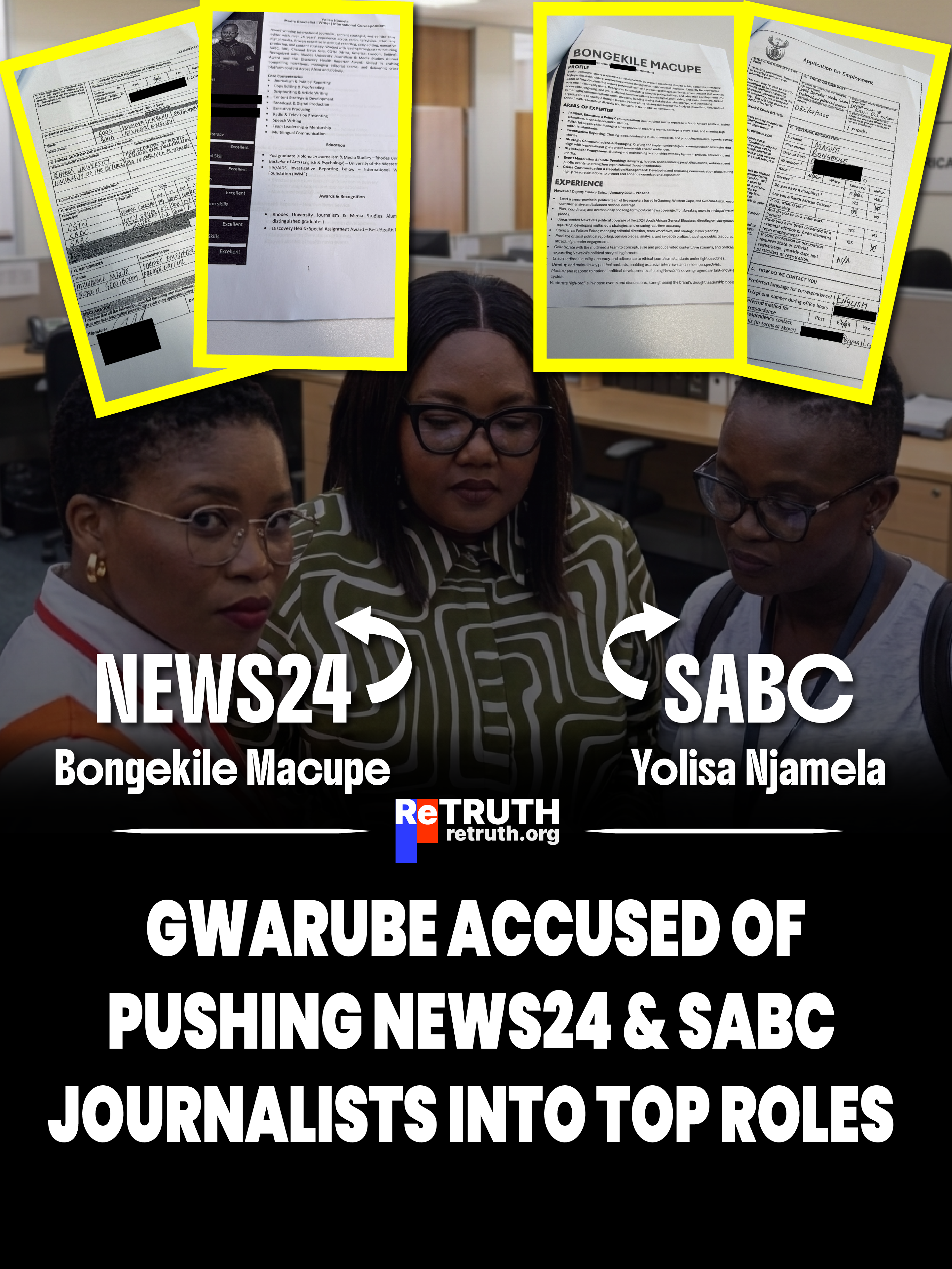
What the documents show is not a minister kept at arm's length from sensitive staffing decisions. They show a minister at the centre of them.
A 17 March 2026 internal Department of Basic Education presentation reviewed by this publication suggests Minister Siviwe Gwarube played a decisive role in at least two high-stakes processes: the appointment of the Deputy Director-General for Curriculum Policy, Support and Monitoring, and the recruitment process for Chief Director: Media Liaison and National and Provincial Communication.
The documents do not, on their own, prove the wider allegations now swirling around the department - including claims of panel-rigging, intimidation or party-political pressure. But they do sharpen one unavoidable question: did ministerial oversight slide into direct interference?
KEY DATE
WHAT THE DOCUMENTS RECORD
5 May 2025
Interviews for the DDG: Curriculum post are held.
20 May 2025
The panel agrees that two candidates should go forward for Cabinet consideration.
24 June 2025
The minister issues a written decision that only Candidate 2 will be taken forward.
18 Aug 2025
The minister formally approves the recommendation for Candidate 2 as DDG: Curriculum.
15 Nov 2025
In the communications post, the minister declines the shortlist and requests the full list of applicants.
The most striking material concerns the DDG: Curriculum process. According to the presentation, interviews were conducted on 5 May 2025. On 20 May 2025 the panel agreed to submit two candidates for Cabinet concurrence. That should have left the process open to a comparative decision higher up the chain. Instead, the paper trail records a sharp narrowing of options: on 24 June 2025 the minister issued a written decision confirming that only Candidate 2 would be taken forward.
That step matters. It suggests that the minister did not merely sign off at the end of a completed process. She intervened at the point where more than one candidate was still alive in the system and reduced the field herself. By 18 August 2025, the same presentation records that she formally approved the recommendation for the appointment of Candidate 2 as DDG: Curriculum.
The communications recruitment trail points in the same direction. The records show that the minister approved the advertisement, that a shortlisting meeting took place, that minutes were compiled, and that the submission moved through senior departmental channels. Then, on 15 November 2025, the minister is recorded as having declined the shortlist and requested the full list of applicants.
That is not a trivial procedural footnote. A minister rejecting a shortlist after the panel stage and demanding the complete applicant pool raises immediate questions about how far political principals should reach into an administrative hiring process. At minimum, it suggests dissatisfaction with the outcome generated by ordinary recruitment steps. At worst, critics will ask whether the process was being bent toward a preferred result.
The same internal deck names the officials around these decisions. It records HR leadership, the Director-General, the Deputy Minister and the CFO or DDG: Finance and Administration as participating at different points in the governance chain. In other words, these were not stray or informal interventions. The paper trail places the minister's decisions inside formal departmental workflow.
That context is why the broader allegations cannot simply be shrugged off as gossip, even if the current document set does not conclusively prove them. Sources familiar with the controversy allege that stronger candidates were sidelined, that internal processes were shaped to favour outcomes aligned with the minister's preference, and that senior staff felt pressure as the disputes deepened. The documents reviewed here stop short of proving those claims. What they do show is a pattern of concentrated ministerial involvement substantial enough to make the allegations harder to dismiss out of hand.
There is another reason this matters. The presentation itself was framed as an engagement for the Portfolio Committee on Basic Education. Once appointment controversies reach that stage, the issue is no longer an ordinary internal disagreement. It becomes an accountability matter - one that goes to the relationship between ministerial authority, professional administration and parliamentary oversight.
Gwarube, a Democratic Alliance politician serving as Minister of Basic Education, is legally entitled to exercise executive authority over her department. The question raised by these records is narrower and more serious: where is the line between lawful executive oversight and interference in a recruitment process that should retain administrative independence? The documents do not settle that question. They do, however, make it impossible to ignore.
For a department responsible for millions of learners, the stakes go beyond office politics. If senior appointments are perceived to be driven by control rather than process, confidence inside the department weakens, oversight becomes more difficult and the public is left asking whether merit still governs the top of the system. That is why the central issue now is not whether the minister knew about these processes. The documents show that she did. The issue is whether she reshaped them.
Award-winning investigative reporter focused on politics, economy, and social justice in Southern Africa.